
KILLINGLY—The battle over a school mental health center continues in the Killingly, CT school district. For months, the state board of education and the local school board have been sparring over both jurisdiction and alleged negligence by the district.
While the case has become complex, the entire Killingly saga was started by a school survey, produced and administered by SERAC.
Flawed survey data formed the only measurable basis for the initial Complaint
SERAC’s survey asked if students had thought about suicide, or even had a plan to commit suicide. Of the 477 students surveyed, the highest percentage, 31%, was in grade 8 (out of grades 7 - 12).
Sheila Matthews, who leads a non-profit called AbleChild, testified before the state’s Joint Committee of Health and Human Services regarding the survey used to determine the extent of childrens’ mental health, and possible suicidal thoughts.
Matthews showed that behavioral health vendors were supplying data to the state committee that did NOT categorize children according to prescribed drug uptake with a black box label—the strongest any pharma product can carry before being pulled off-market. Black box labels include suicide warnings.
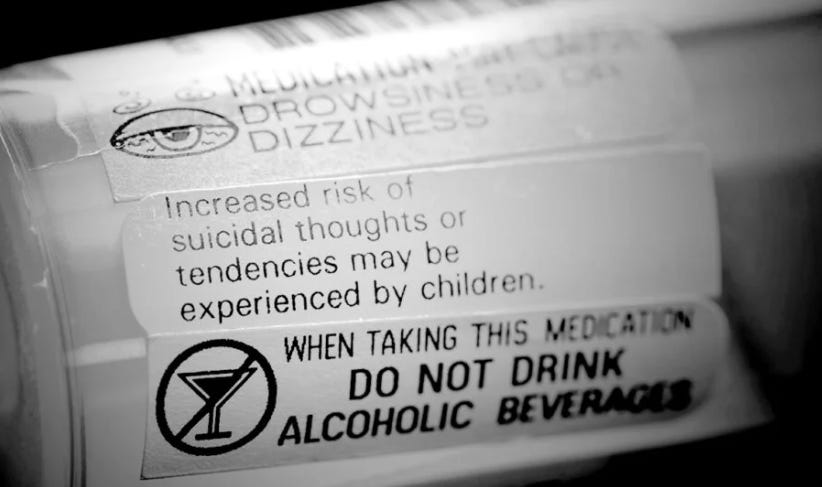
Matthews’ testimony points out that SERAC’s questionnaire failed to ask students a question—such as, “Are you currently taking prescribed medication with a black box warning?”
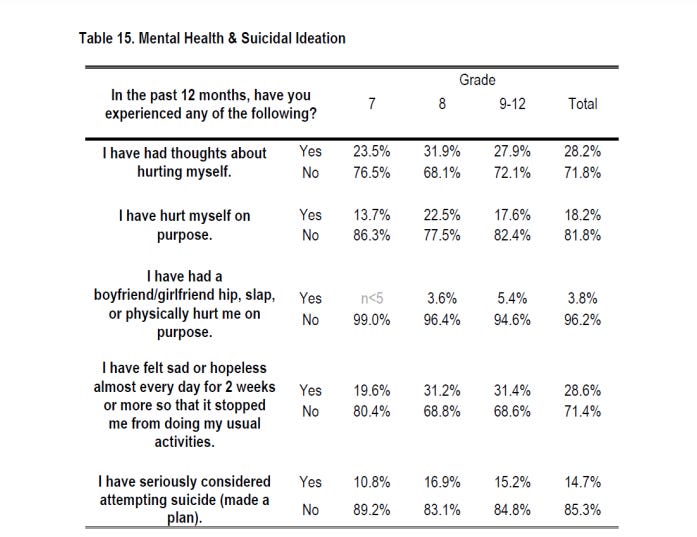
With no knowledge as to whether any of the teens’ suicidal thoughts were induced by duly prescribed drugs, the Killingly board cannot legally be blamed for big societal trends that were actually, perhaps ironically, started by the behavioral health industry.
Andrew Feinstein, the attorney for the Complainants, appears to have conflicts of interest
AbleChild filed an ethics complaint against attorney Feinstein, a registered lobbyist, because he serves on both the boards of SEEK (Special Education Equity for Kids) and COPAA (Council of Parent Attorneys and Advocates).
COPAA received a $10,000 donation from a law firm, Latham & Watkins.
It is unknown whether this donation may have been used in part to pay legal fees to attorney Feinstein. It has not been disclosed as to exactly who is paying the fees for litigating the Complaint. Latham & Watkins is a global law firm for the behavioral health and pharmaceutical industry.
The legal terrain ahead will set precedent—state legislators are paying attention
The state board took action after 18 months, against the Killingly board, by dismissing all 12 of their filed motions at the last minute, making illegal votes in executive session. Attorney Stevenson quickly filed an emergency complaint with the Freedom of Information Commission on alleged meeting violations.
On November 8th, 9th and 10th, Stevenson filed 3 Complaints (first, second, third) with the Freedom of Information commission, regarding the state board’s actions. Board chair Norm Ferron also penned a letter to Representative Jeff Currey and Senator Doug McCrory, who have expressed an interest in the Killingly battle.
House minority leader Vince Candelora has called the scrutiny of the Killingly board’s actions ‘a witch hunt’, and has also pointed out that the survey is the only source of data.
Yet another egregious violation of due process will take place—the accused, not the accuser(s), will be asked to go first. Imagine not knowing exactly what crime you’re being accused of, and then having to answer first to defend against your still-unrevealed crime.
The primary outlet covering Killingly’s controversy has massive funding from left-leaning activists
The media outlet most covering the Complaint and further developments has been the CT Mirror. George Colli’s investigation into their funding made the rounds on X feeds. Not surprisingly, the Mirror—represented by reporter Ginny Monk—has always sided with the Complainants.
What Killingly’s battle means, for every CT district
The legal and health dangers for public schools in CT have reached a new threshold. The state board accepted a case based on a flawed survey; but the state board never articulated the substance of any claim of negligence.
Instead, Killingly’s local decisions have been compromised; the state board has made it clear they can do as they please, when they please. The recent elections mean local board control will go to the Democrats. Vice chair Martin thinks that to ‘save face’, the state board will soon pass the buck back to the local board, trusting the new leadership to ‘do the right thing’.
The hearing between the state board and Killingly’s board will be held Wednesday, November 15th.
Sally Finck is editor in chief of the Continental Tribune, LLC.